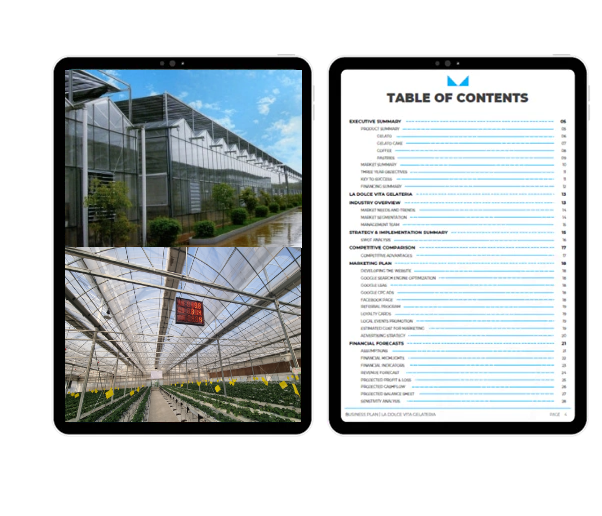
Create a business plan to start a hydroponic farm with Hydroponic Farms Australia
Have a smooth journey to your hydroponic farming business with the help of our of experts
Our goal is to make each vertical farm profitable, so we provide full support before and after setting up a farm
Business Plans For Every Stage of Your Startup
Bespoke Business Plan
Have a bespoke business plan created for your business.
All Business Plan orders include a 60-minute consultation with one of our consultants.
Content
Business Overview
Executive Overview Company Strategy
Swot Analysis
Industry and Market Analysis
Marketing Overview
5 Year Financial Forcast
Investor pack
An Investor Pack includes a Bespoke Business Plan, a 5-Year Financial Forecast, and a Pitch Deck to assist your business in its funding round. All documents are designed to reflect your brand identity.
Content
Bespoke Business Plan
VC Ready Pitch Deck
5 year Financial Forcast
3+ Hours Of Strategic Consulting
Design Your Farm And Build Your Farm
Green House Design
Determine the greenhouse's dimensions based on the available space and your cultivation requirements. Plan for sufficient space for both the hydroponic system and the vegetation you intend to cultivate.
Select the most suitable greenhouse type for your climate and budget. Each of the available options, freestanding greenhouses offer distinct advantages.
We use excellent construction supplies to ensure the structure's durability and longevity that offer adequate insulation and UV protection.
Ventilation: Install ventilation systems to regulate the greenhouse's temperature and relative humidity. Airflow is essential for preventing heat accumulation and controlling disease.
Automation and Controls: Integrate automated systems and controls to regulate illumination, temperature, and nutrient delivery. These innovations can optimize plant growth and streamline operations.
Insulation: Insulate the greenhouse to maintain a constant temperature and shield plants from extreme weather.
Hydroponic System Configuration
Choose the hydroponic method that corresponds with your preferences and the varieties of plants you wish to cultivate. Deep water culture, nutrient film technique, and ebb and flow are common techniques.
Establish a nutrient reservoir in which to store the nutrient solution. Ensure that it is positioned securely and shielded from light to prevent the growth of microorganisms.
Install Grow Beds or Channels: Install grow beds or channels to contain the growing medium and support the plant's roots.
Install Piping and Tubing: Install the piping and irrigation tubing necessary to transport the nutrient solution to the grow beds or channels. Install a pump for solution circulation.
Add Lighting: Install suitable illumination fixtures to supplement natural light, particularly in regions with limited daylight hours.
Test the System: Conduct a comprehensive test of the hydroponic system to ensure that it functions accurately and effectively.
Crop Selection and Management of Nutrients
Choosing the correct plants for your hydroponic greenhouse is crucial to its success. We consider the following factors when selecting vegetables to cultivate:
Climate Compatibility: Choose plants that thrive in the climate conditions of the greenhouse. Some plants flourish in warmer climates, whereas others favour cooler temperatures.
Growth Cycle: Consider the growth cycle of the plants and how it relates to your production objectives. Some crops mature rapidly, allowing for a higher turnover rate and continuous harvesting.
Space Requirements: Ensure that the selected plants work well within the available space and that the greenhouse is not overcrowded.
Market Demand: Consider the market demand for crops. Producing in-demand crops can increase a business's profitability.
It is crucial to manage nutrient levels to promote healthy plant growth after selecting your crops. Follow these practices for nutrient management:
Nutrient Solution: Prepare a balanced nutrient solution that contains all the essential macro- and micronutrients required by the plants. Regularly monitor and adjust the nutrient solution to maintain optimal concentrations. You can also use pre-blended nutrient solutions.
pH Control: Maintain a keen watch on the pH level of the nutrient solution. Most plants prefer a pH range between 5.5 and 6.5 for optimal nutrient absorption.
EC (Electrical Conductivity) Level Monitoring: Measure the Electrical Conductivity (EC) level of the nutrient solution to ensure that the concentration of dissolved ions is within the acceptable range for the selected plants.
Delivery of Nutrients: Ensure that the nutrient solution is efficiently delivered to the root systems of the plants. Distribution is essential for achieving uniform growth and robust yields.
Nutrient Supplements: Consider using nutrient supplements such as calcium and magnesium (calmag) to address plant-specific requirements and prevent nutrient deficiencies.